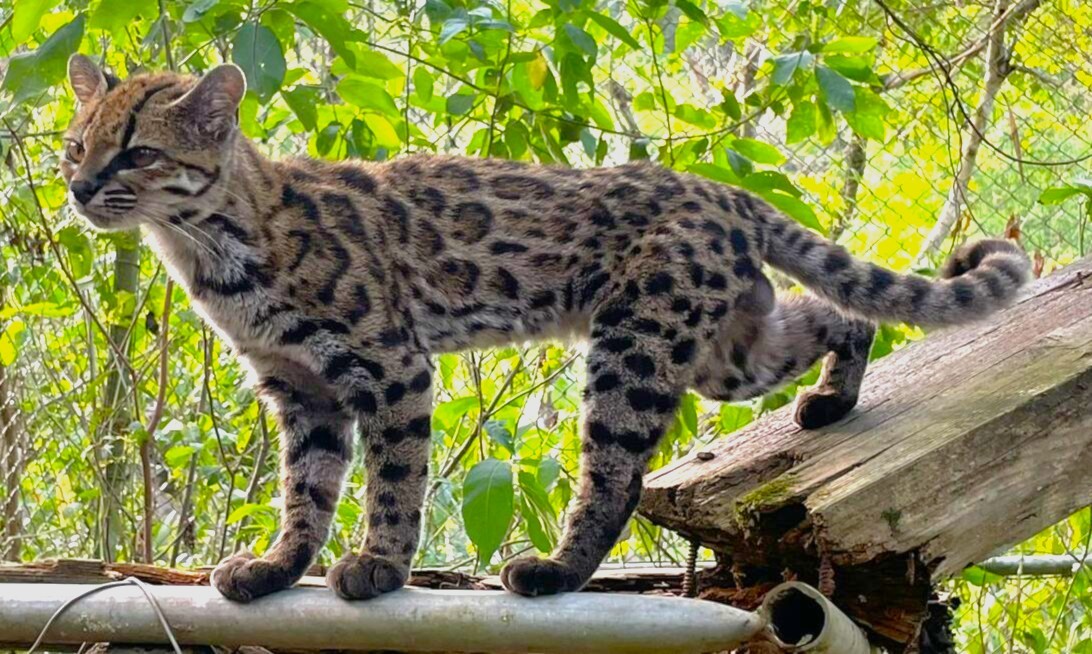
The first new cat species to be formally described in more than 100 years had been discovered in Bolivia’s Yungas cloud forest .The small wild cat species was already familiar to local communities and were thought to be oncilla (Leopardus tigrinus); however, genome sequencing from both museum bone specimens and living animals determined the cats are a distinct species, tilcayo (Leopardus tilcayo).
Bolivian biologist, Paola Nogales-Ascarrunz, first came across the species in 2017, at the Senda Verde Wildlife Sanctuary, in the Yungas area of Bolivia. The privately run animal refuge contacted Nogales-Ascarrunz after a cat was handed over to their care after spending a year living with a local man who found it as a kitten and initially believed it was a domestic cat.
The name “tilcayo” was already used for the species by local communities in the region, which in an interview following the announcement of the species identification, Nogales-Ascarrunz said stated likely comes from t’ili kayu, or ‘tiny foot’, according to native Aymara speakers who had reached out through social media.
It was not until 2019, when preparing a booklet of Bolivian cat species, that Nogales-Ascarrunz realised her photos of the tilcayo she had taken at the wildlife sanctuary appeared distinct to the oncilla, and genomic analysis began, which later determined the cat was indeed a new species. So closely to the tilcayo physically resemble other species, they are considered a cryptic species, meaning they are difficult to distinguish from other species by morphology, the study of form or shape, alone.
The genomic analysis was conducted as part of a larger study which began in 2013 to genetically survey tiger cats, the first study of its kind for the genus.
“Importantly, our study did not rely only on fresh samples,” Nogales-Ascarrunzsaid.
“We also analysed specimens preserved in natural history museums, showing how these collections can provide valuable genetic information and help answer questions that would otherwise be difficult or even impossible to investigate.”
In total, the study analysed the complete genomes of 38 cats in the Leopardus genus, including 26 tiger cats.
“Our current study presents the most complete genetic study yet, including that key missing element: DNA from tiger cats in the Guianas, which is the location where the original tiger cat L. tigrinus had been described in 1775,” lead study author Jonas Lescroart said.
Lescroart notes that the two currently accepted species of tiger cat (L. tigrinus and L. guttulus) are classified as vulnerable under the IUCN Red List of Threatened Species, and that the team are calling for a re-evaluation of all of these species’ population health.
“We have already shared our findings with IUCN and in their upcoming reassessment of tiger cats, they will treat each unit separately, which will result in more accurate assignment of conservation categories,” he said.
JULIA GARDINER