
The Veterinarian is pleased to welcome Peter Buss as its South African correspondent for Crane Post. Here, we present an article by Peter on a problem we suspect not many local vets would have encountered!
White rhinos (Ceratotherium simum simum) are more than iconic megafauna, they are essential for maintaining the ecosystem health of conserved areas within Southern Africa. Their conservation story is one of remarkable recovery, but it comes with complex veterinary challenges. This article explores their ecological role, historical journey, and the physiological risks associated with immobilization, along with advances in mitigating these risks.
Rhino, as mega-herbivores, consume vast quantities of grasses which assist in maintaining open grasslands, prevents bush encroachment, and promotes biodiversity. This creates habitats for smaller grazers such as impala and wildebeest and ground-nesting birds that depend on open spaces. The distribution of their dung contributes to nutrient cycling and seed dispersal, while dung middens create microhabitats that support insect communities which in turn attract birds and other species. As ecological engineers, their trails and wallows influence water runoff and create areas that collect rainwater to the benefit of other wildlife, especially during dry periods.
First recorded in South Africa by a European naturalist in 1820, white rhino had been hunted to the point of extinction by the early 1890s. A surviving population of approximately 50 individuals was discovered in 1895 at the confluence of the White and Black Umfolozi Rivers in northern Natal Province. Their survival was secured through the proclamation of the Hluhluwe-Umfolozi Game Reserve (Africa’s oldest proclaimed reserve) and the iSimangaliso Wetland Park (Lake St Lucia Game Reserve) as well as legal protection as “Royal Game“. By 1952, the population had increased to 437 individuals and by 1965, 912 rhinos occupied an area of 118,000 acres.
The increase in this population, represented a relative overpopulation of a species on the brink of extinction. The density of rhino was dangerously high for a single population and posed new risks: increased susceptibility to a novel or endemic disease, starvation in the event of a drought, and increased competition with other animals for limited resources. It had become imperative to reduce the density of rhino. This required the capture and relocation of rhino, a task that demanded innovative approaches. Immobilizing-drug protocols, safe handling techniques, and specialised translocation equipment did not exist and had to be developed from scratch, often through trial and error.
Fast forward to today and white rhinos have been successfully reintroduced across their former range within South Africa, including national parks and private game reserves, and into Botswana, Namibia, Angola, and Mozambique. By 2012, numbers exceeded 20,000, an incredible conservation success story. Unfortunately, escalating poaching for rhino horn has reversed this trend over the past 15 years, reducing the population to approximately 15,500 individuals
The redistribution and increase in the population of white rhino owes much to early pioneers such as Dr A.M. Harthoorn and Dr I. Player, who developed suitable drug combinations for the chemical capture of rhino. The successes achieved in immobilizing and moving rhino within South Africa and to neighbouring countries suggest that these combinations are well suited for use in rhino. However, research over the past decade has revealed significant associated morbidity and mortality risks. These findings have also driven the development and evaluation of appropriate interventions to mitigate these risks during capture operations.
In free-ranging rhinos, the primary immobilizing drug remains etorphine, a potent opioid approximately 10 000 times stronger than morphine. Its potency allows for sufficient volume to be administered using a dart, usually with less than 3ml capacity. The goal is to induce recumbency as quickly as possible after darting, typically within 5-7 minutes, to limit metabolic and physiologic imbalances and to reduce injury risks as the drug is taking effect. Etorphine is frequently combined with azaperone, a tranquilliser that both shortens induction time and assists in stabilizing cardiovascular responses in the affected animal.
Opioids can cause significant respiratory compromise, and this is certainly the case in etorphine-immobilised white rhino. Normally, in an awake animal, increased blood carbon dioxide levels (hypercapnia) stimulate breathing with increased movement of air in and out of the lungs, and the opposite occurs as levels decrease. In immobilised rhino, etorphine depresses sensors in both the brain stem and aortic bodies that respond to circulating carbon dioxide levels. Inhibition of these sensors results in breathing no longer being controlled by carbon dioxide but rather by the severely decreased blood oxygen levels (hypoxaemia), usually approaching 25 per cent of normal concentrations. A lack of sufficient oxygen causes a switch from aerobic to anaerobic metabolism to produce the energy required for cellular homeostatic functions. Increased lactic acid production can result in a decrease in pH or acidosis.
Hypoxaemia and hypercapnia are not solely caused by reduced ventilation. Blood pressure changes in the vessels of the lungs inhibit the movement of gases, especially oxygen, between alveoli and surrounding capillaries. These changes include a mismatch between those alveoli receiving air and getting an adequate blood supply. Elevated pressures in the pulmonary vascular likely contributes to lung oedema, like exercise-induced pulmonary haemorrhage observed in racehorses, further restricting the movement of oxygen between lungs and blood.
Recent research findings indicate that etorphine increases metabolic activity in immobilised white rhino. This increase is often observed clinically in the recumbent animal as generalised shaking, muscle trembling and limb paddling. This increased metabolism consumes additional oxygen which is already in short supply because of impaired breathing and lung functions. Additional carbon dioxide is added to the blood which lowers pH potentially leading to cardiovascular and neurological depression, hypotension, and, in severe cases, multiple organ dysfunction.
The large body mass of rhino adds to the complexity of respiratory dysfunction. It has been demonstrated, using electrical impedance tomography (EIT), that there is compression of the lower lung in the laterally recumbent immobilised individual caused by gravity and the weight of the upper lung and heart pushing downwards. This compression of the dependent lung, causes significantly less movement of both air and blood, reducing total lung functional capacity by over 50 per cent.
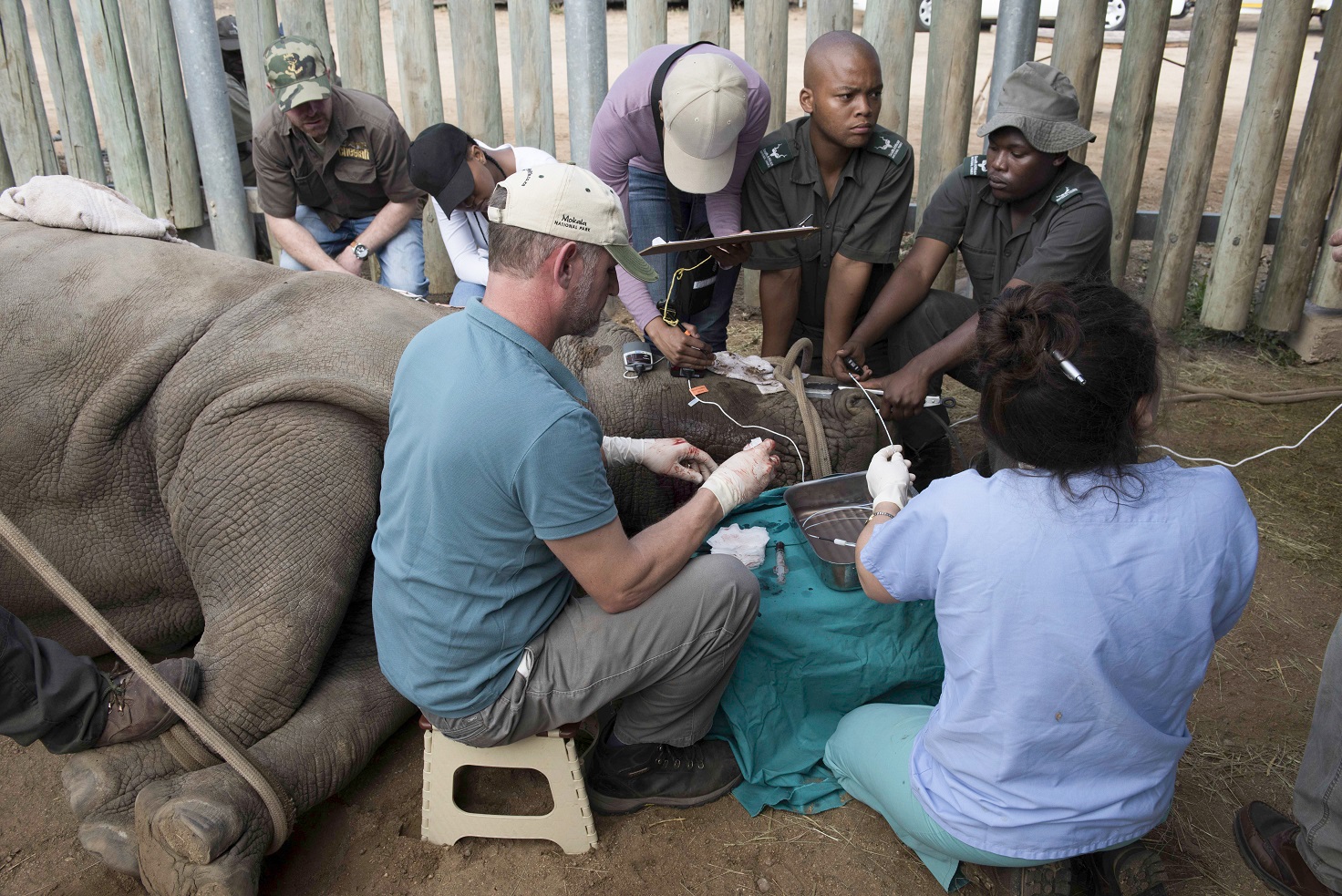
Our research has demonstrated that there are multiple pathophysiological changes in an immobilised rhino that significantly increase morbidity and mortality risks. Despite these challenges, most rhino survive immobilization. Losses have occurred when additional stressors are present, e.g., systemic infection resulting from traumatic injury, nutritional compromise during drought, or increased body temperature associated with the stressors of chemical capture. Overheating must be guarded against, especially if drug administration by dart is from a helicopter or the capture takes place in high environmental temperatures.
Apart from identifying the physiological changes that cause hypoxaemia and hypercapnia, research has investigated mitigating interventions to reduce risks in immobilised rhino. Results indicate that the administration of butorphanol, an opioid, has beneficial outcomes. Butorphanol is commonly used in domestic animals as an analgesic and sedative, especially prior to surgery. In immobilised rhino, it improves blood oxygen and carbon dioxide levels and partially reverses etorphine induced sedation. These effects are the result of butorphanol interacting with multiple opioid receptor subtypes, exerting either agonistic or antagonistic activity depending on the specific receptors it occupies. Importantly, the intravenous administration of this opioid reduces metabolic oxygen requirements and the resulting carbon dioxide produced in the immobilised rhino. The net result is blood oxygen levels improve with more becoming available to supply critical tissues such as the heart and brain.
The provision of supplementary oxygen in an animal experiencing opioid induced respiratory depression would appear to be a first-line intervention. However, immobilised white rhino suffer from a reduced movement of air into and out of the lungs, and not a lack of available oxygen. Under ideal circumstances, the treatment of choice would be intermittent positive pressure ventilation. Unfortunately, in the field, this intervention is impractical because of the logistical challenges associated with getting a ventilator of sufficient capacity to the immobilised animal. Providing supplementary oxygen via an intranasal tube results in limited improvements in blood oxygen level and may paradoxically reduce the hypoxic drive that maintains breathing. However, if an immobilised rhino is administered butorphanol prior to insufflation with oxygen, blood oxygen levels return to those found in an awake rhino at rest. The mechanism for this improvement remains unclear. Although the use of supplementary oxygen can improve hypoxaemia, the amount of carbon dioxide in the blood may continue to increase and result in a worsening acidaemia.
Despite six decades since the first white rhino were captured and relocated, immobilization of rhino using a potent opioid remains clinically challenging to manage because of multiple pathophysiological disruptions resulting in increased morbidity and mortality risks. Despite this, most white rhino survive these homeostatic challenges, however it does not allow for complacency. Risks are amplified in compromised individuals, often undetectable before darting, and require proactive management, especially under conditions that increase metabolic stressors.
White rhinos are ecological keystones and conservation icons. Their survival depends not only on anti-poaching efforts but also on veterinary expertise in managing the physiological challenges of immobilization. Continued research and innovation including improved drug protocols and field interventions are essential to safeguard these animals during capture and translocation, ensuring their role in maintaining Africa’s savannas for generations to come.
Peter Buss BVSc MMedVet (wildlife) PhD
Peter Buss received his Veterinary Science degree from the University of Queensland, Australia, in 1985 and commenced his veterinary career working in a mixed for two years. He subsequently spent three years working as a locum in various practices in the south of England. In 1991, Buss moved to South Africa and studied for a Master’s degree in Veterinary Medicine, specializing in wildlife. From 1993 to 1998, he worked at the National Zoo, Pretoria, initially as a veterinarian and later as General Curator. He joined the Faculty of Veterinary Science, Onderstepoort, and lectured in pharmacology and anaesthesiology. 2002 saw the realisation of Buss’s lifelong ambition to work in wildlife conservation with his appointment as a veterinarian in the Kruger National Park. Buss was awarded a PhD which investigated the physiological effects of immobilization in white rhinoceros. He is currently involved in research projects investigating the pharmacophysiology of immobilizing drugs in multiple species, and KNP ecosystem diseases including Foot-and-Mouth Disease Virus and Bovine Tuberculosis. He currently works as a Specialist Wildlife Veterinarian for South African National Parks (SANParks) and is based in Kruger National Park (KNP).