Pets have long been a quiet but constant presence in artists’ lives. Sharing studios and homes, they offer routine, companionship, and moments of interruption that shape the rhythms of making art. Sometimes, they also enter the artwork itself!
Henri Matisse’s cats and doves reflected his interest in form, movement, and everyday intimacy, Frida Kahlo’s animals became extensions of her identity and cultural beliefs, and David Hockney’s dogs anchored his domestic world. For these artists, pets were more than companions; they were woven into the very fabric of their artistic practice.
Henri Matisse (1869–1954) was one of the leading figures of modern art, known for his bold use of colour, fluid forms, and innovative approach to composition. Though he worked across painting, drawing, printmaking, and sculpture, Matisse is best remembered for his vibrant works that blend decorative patterning with simplified, expressive forms. Matisse’s studio was not only a space for experimentation with form and colour, but also a home to animals, particularly cats, who became both companions and subjects.
Matisse had a lifelong affection for cats and had three of his own: Minouche, Coussi, and the black cat, La Puce. Felines were frequently depicted in his paintings, such as Cat with Red Fish (1914) and Girl with a Black Cat (1910), the latter portraying his daughter Marguerite alongside what was possibly one of the family pets. Like his human muses, his cats were rendered with flat planes of vibrant colour, simplified outlines, and fluid contours, reflecting the same decorative and expressive qualities that define Matisse’s Fauvist and later work.
Matisse was also a keeper of doves, who served as artistic inspiration and featured in his famed cut-outs. Watching the birds he kept in his studio, Matisse said:
These repeated figures of dove, their spheres, their curves, glide in one as in a large interior space. When I am doing the cut-outs, you cannot imagine to what degree the sensation of flight which comes to me helps me better to adjust my hand as it guides the path of my scissors. It’s hard to explain. I would say that it is a kind of linear equivalence of the sensation of flight. There is also the question of a vibrant space. To give life to a feature, to a line, to make a form exist.
The doves also inspired Matisse’s friend and fellow artist Pablo Picasso, who looked after the birds on occasion. In 1949, Picasso produced a lithograph depicting a white dove against a black background. This work was used to illustrate a poster for the 1949 Paris Peace Congress; the dove widely considered a symbol of peace.
Frida Kahlo (1907–1954) was a Mexican painter celebrated for her vivid self-portraits and works deeply rooted in Mexico’s popular culture. Blending folk-art traditions with elements of surrealism, she used symbolism and personal narrative to explore identity, gender, and the social realities of her country. Much of her art emerged from her experiences with illness and chronic pain. She was raised at La Casa Azul in Coyoacán and had planned to study medicine, but a devastating bus accident at eighteen reshaped her life. During her recovery, she returned to drawing and discovered the artistic voice that would make her an icon. She also surrounded herself with animals, many of whom would later appear in her work.
Among these companions was a fawn named Granizo, who wandered freely through the Casa Azul. Granizo appears in The Wounded Table (1940), and in 1946, Kahlo famously depicted herself as a deer, using her pet as a model. Birds were equally prominent. In Me and My Parrots (1941), she poses with four feathered companions, while that same year, her amazon parrot Bonito, appears in Self-Portrait with Bonito. Kahlo filled the Casa Azul with parakeets, macaws, hens, and sparrows, and even kept an eagle named Gertrudis Caca Blanca, on account of her propensity to leave white droppings throughout the courtyard.
Kahlo’s love for Mexico’s ancient heritage found powerful expression in her bond with the Xoloitzcuintle, the hairless Mexican dog whose lineage stretches back to the Aztecs. Her favourite, Mr. Xolotl, appears repeatedly in her paintings and drawings, not just as a pet, but as a living emblem of Mesoamerican identity. The breed’s name itself carries layers of meaning: it honours the god Xolotl (the dog-headed aspect of Quetzalcoatl), believed in pre-Hispanic narratives to have created the Xolo, while itzcuīntli is the Nahuatl word for dog. Ancient groups in the Valley of Mexico, including the Chichimen of Xolotl or dog people, further attest to the animal’s deep cultural roots.
Kahlo embraced the Xolo as both companion and symbol. In her diary, she sketched her canine friend with the caption, “The Lord Xolotl, AMBASSADOR of the Universal Republic of Xibalba Mictlan.” The dog appears in The Love Embrace of the Universe, the Earth (Mexico), Myself, Diego, and Señor Xolotl, standing as both guardian and cultural marker. Her husband, Diego Rivera, also included Xolos in his murals at the Palacio Nacional.
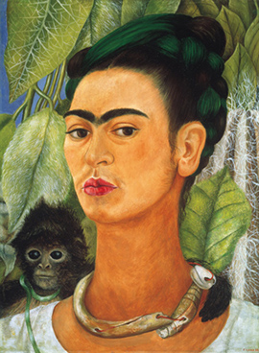
Central American spider monkeys were another vital part of Kahlo’s emotional and symbolic world. Fulang-Chang, a gift from Rivera, and Caimito de Guayabal lived with her at the Casa Azul and appear in paintings such as Fulang-Chang and I, where the monkey occupies the foreground. In Aztec cosmology, monkeys symbolised fertility, creativity, and artistic expression, associations Kahlo invoked repeatedly, as in Self-Portrait with Small Monkey (1945), where a spider monkey and a Xoloitzcuintle join her.
At the Casa Azul, Kahlo’s animals were companions and sources of comfort, integral to her life and work. Through these relationships, she crafted an identity that was personal, cultural, and entwined with Mexico’s natural and mythic traditions. In 2017, Monica Brown and John Parra celebrated this side of Kahlo in Frida Kahlo and Her Animalitos, a children’s book honouring her beloved companions.
David Hockney (born 1937) is an English painter (among many other creative pursuits) widely regarded as one of the most influential British artists of the 20th and 21st centuries. A key figure in the Pop Art movement of the 1960s, Hockney is perhaps best known for his vibrant depictions of California swimming pools, but his work spans a remarkable range of mediums, including painting, printmaking, photography, and even digital art. Over his long and illustrious career, one of the defining aspects of Hockney’s life and work has been his deep affection for his dogs.
Hockney’s fondness for dachshunds began in 1987 when he adopted his first pair, Stanley and Boodgie, and they quickly became a recurring subject in his art. Between 1993 and 1995, Hockney created hundreds of images of his beloved pets, capturing their personalities with warmth, humour, and precision. In a series of paintings and sketches, he portrayed Stanley and Boodgie in playful, domestic, and sometimes whimsical settings, highlighting both their charm and their individuality. These works often feature the dogs in relaxed poses, lounging across furniture or interacting with one another, conveying a sense of intimacy and shared life that reflects Hockney’s own affection for them.
Hockney’s dogs also serve as a bridge between his personal life and public art, offering viewers insight into the private, domestic world that has inspired much of his practice. Their repeated presence in his paintings emphasises continuity and affection, while also allowing Hockney to experiment with perspective, pattern, and space in ways that are characteristic of his broader body of work. By focusing on Stanley and Boodgie, Hockney elevates the everyday companionship of pets into a subject worthy of artistic attention, showing that the love and observation shared between artist and animal can yield masterpieces of work.
Speaking about the role his dogs play in his artmaking, Hockney said:
I realised I was painting my best friends, Stanley and Boodgie. They sleep with me; I’m always with them here. They don’t go anywhere without me, and only occasionally do I leave them. They’re like little people to me. The subject wasn’t dogs but my love of the little creatures.
Across their studios and canvases, Matisse, Kahlo, and Hockney demonstrated how pets can serve as muses, symbols, and close companions in the creative process, with their animals leaving lasting imprints on the artworks and lives of the artists themselves.