Epitaph to a Dog
Near this Spot
are deposited the Remains of one
who possessed Beauty without Vanity,
Strength without Insolence,
Courage without Ferosity,
and all the virtues of Man without his Vices.
This praise, which would be unmeaning Flattery
if inscribed over human Ashes,
is but a just tribute to the Memory of
Boatswain, a Dog
who was born in Newfoundland May 1803
and died at Newstead November 18th 1808
This memorial eulogy introduces the 26‐line poem that one of the leading figures of the Romantic movement, Lord Byron, wrote for his beloved Newfoundland dog, Boatswain. George Gordon Byron, 6th Baron Byron (22 January 1788–19 April 1824) was as famous for his flamboyant personality and eccentric lifestyle as for his poetry. The son of the dashing but reckless Captain ‘Mad Jack’ Byron and the Scottish heiress Catherine Gordon, he rose from a modest childhood in Aberdeen to inherit the title and estate of his great-uncle, the 5th Baron Byron, at the age of ten. A lifelong animal lover, Byron made sure to surround himself with a vast menagerie, even hauling his companions around Europe, as it troubled him to leave them behind. Though some of his contemporaries hinted that it was self-indulgence that drove his eccentric animal keeping, Byron went to great lengths to provide for those in his care. Moreover, he was sympathetic to any animal’s suffering, no matter how small the beast, how wild or how seemingly inconsequential.
At 15 years old, Byron acquired Boatswain the Newfoundland, who would become one of the poet’s most beloved companions, that was, when the dog was permitted entry. Byron was educated at Trinity College, Cambridge, but when he commenced, he was appalled to learn that Boatswain could not come with him. To get around this prohibition and soothe his umbrage, he decided to keep a bear instead, there being no directives about ursine companions in the college statutes.
I have got a new friend,” he wrote, “the finest in the world, a tame bear. When I brought him here, they asked me what I meant to do with him, and my reply was, “he should sit for a fellowship.” This answer delighted them not.
The bear accompanied Byron when he returned to his ancestral home of Newstead Abbey in Nottinghamshire, and it became one of the many animals that would end up living on the sprawling property. Writing to his sister, Abbey visitor C. S. Matthews gave her advice, should she ever decide to make the journey to come to Newstead,
But have a care how you proceed; be mindful to go there in broad daylight, and with your eyes about you. For, should you make any blunder, — should you go to the right of the hall steps, you are laid hold of by a bear; and, should you go to the left, your case is still worse, for you run full against a wolf!
When Lord Byron took up residence in Ravenna, Italy, many of his animals came with him. Fellow romantic poet Percy Bysshe Shelley described Byron’s lifestyle, highlighting how,
Lord B.’s establishment consists, besides servants, of ten horses, eight enormous dogs, three monkeys, five cats, an eagle, a crow, and a falcon; and all these, except the horses, walk about the house, which every now and then resounds with their unarbitrated quarrels, as if they were the masters of it…
[P.S.] I find that my enumeration of the animals in this Circean Palace was defective…I have just met on the grand staircase five peacocks, two guinea hens, and an Egyptian crane. I wonder who all these animals were before they were changed into these shapes.
For better or worse, the animals lived amongst Byron’s belongings and amongst each other. This, naturally, could lead to conflict. Writing to Irish writer, poet, and lyricist Thomas Moore, Byron described how he had been,
Scolding my monkey for tearing the seal of [Madame Sophie Gail’s] letter, and spoiling a mock book, in which I put rose leaves. I had a civet-cat the other day, too; but it ran away, after scratching my monkey’s cheek, and I am still in search of it. It was the fiercest beast I ever saw, and like—in the face and manner.
Byron was forgiving when his animals caused trouble, even if he was on the receiving end of their ferocity. In 1807, he wrote to his friend and supporter Elizabeth Bridget Pigot, telling her how his bulldog puppy, Savage, the finest puppy he had ever seen, showed his teeth. “In his great and manifold kindness, he has already bitten my fingers, and disturbed the gravity of old Boatswain, who is grievously discomposed.” Another time, when one of his parrots gave him a bite nasty enough to draw blood, the poet turned to her calmly. Using the words of Macheath from John Gay’s The Beggar’s Opera, Byron caressed the bird and simply asked, “Was this well done, Jenny?”
In true Romantic fashion, the poet was seemingly unable to abide seeing an animal in distress. When in Pisa, Byron witnessed a monkey being mistreated on the street, so he bought it. During a violent storm at sea, the horses on board broke loose from the ship’s stabling. Byron stayed on deck through most of the night, attempting to calm them and prevent them from injuring themselves in their terror. On a journey from Pisa to Genoa, he travelled with geese, which he planned to slaughter and eat in celebration of Michaelmas. When it came time to wring their necks, though, Byron could not give the order and, instead, he decided to let them remain alive. In Genoa, the geese ended up living in the yard and happily waddled around the lower floor of the house and the garden.
Byron also detested hunting. He once shot an eaglet, and though he tried to save it, the bird ended up succumbing to its injuries. Guilt-ridden, he “never did since, and never will, attempt the death of another bird.” Any target practice thereafter was reserved for inanimate objects. He also refrained from fishing, especially angling, which he deemed a barbaric “pretended sport” of which not a single participant could be deemed a “good man.” Those in his circle also noted that he mostly ate bread and vegetables, turning away from animal flesh.
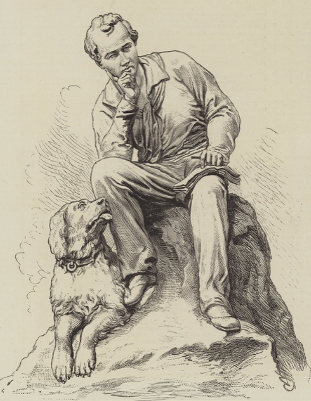
Now, to return to Boatswain. In 1807, Elizabeth Bridget Pigot (to whom Byron recounted his encounter with Savage the puppy) rendered the man and his dog in watercolour. The image accompanied a short story in verse called The Wonderful History of Lord Byron and his Dog. The creation of this was timely as the next year, the Newfoundland contracted rabies. The story goes that Byron did his best to nurse his companion back to health, seemingly without regard for his own safety in the face of the disease. Unfortunately, though, there was nothing the poet could do to save him.
“Boatswain is dead!” Byron lamented, “He expired in a state of madness…after suffering much, yet retaining all the gentleness of his nature to the last, never attempting to do the least injury to anyone near him.” Despite being in dire financial straits at the time, Byron commissioned an enormous marble funerary monument to be installed on the grounds of Newstead, which ultimately proved to be larger than his own. In his 1811 will, Byron also requested that he be buried with Boatswain, though the poet came to rest in the Church of St. Mary Magdalene in Hucknall, Nottinghamshire, after dying in the Greek War of Independence. Sadly, Byron feared that even in death, the companions would not be reunited.
But the poor Dog, in life the firmest friend,
The first to welcome, foremost to defend,
Whose honest heart is still his Master’s own,
Who labours, fights, lives, breathes for him alone,
Unhonour’d falls, unnotic’d all his worth,
Deny’d in heaven the Soul he held on earth.
While man, vain insect! hopes to be forgiven,
And claims himself a sole exclusive heaven.
Elizabeth Burrell